 Informationen
 Informations
 Πληροφορίες του NLUK
Visit us on

Copyright © 2022 Kreta-Umweltforum
Geology / Palaeontology
During the Palaeocene (65.5-55.8 million years before today)
the island of Crete was part of Aegean mainland. Its current
form established through new soil movements and the quaternary
earth folding in the Pliocene age (5.3-1.8 million years ago)
These tectonic operations cut off the island from the Aegean
continental plate in their unusual, elongated narrow shape.
New fractures and shifts of the Earth's crust have created
the islands relief facing, the final today's form was last
by movements of the fixed earth's crust. The latest strata
are deposits from the Quaternary (1.8 million years), where
mammal fossils can be found.
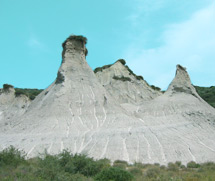
Marl-Cone in Potamida/North west Crete, sediment included fossils from the upper Miocene age
Leaflets
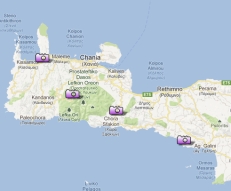
017-04/E - Geotope on Crete 043-04/E - Excursion to Omalos-Plateau 054-04/E - To the geomorphology of Crete 081-05/E - Geological structure of Crete 101-05/E - Geotype in Agios Pavlos 123-05/E - Earthquake on Crete
160-06/E - Santorin volcano exploded 100 years earlier!
400-12/E - Geological excursion Vrisses, Askifou to Chora Sfakion 412-13/E - Mirsini (Northeast Crete) offers a lot geological 413-13/E - About the gypsum deposits of Crete
Please see 2nd Page of the leaflet
for the individual topic
053-04/E - Palaeoanthropology I:
Homo floresiensis
054-04/E - Palaeoanthropology II:
Homo neanderthalensis
062-04/E - Palaeoanthropology III:
Homo heidelbergensis
063-05/E - Palaeoanthropology IV:
"Art at skulls"
066-05/E - Palaeoanthropology V:
"Tsantsa" - shrunken heads
074-05/E - Palaeoanthropology VI:
Pierolapithecus catalanicus
063-05/E - Triconometric connection of Crete to Africa 081-05/E - Lefka Ori (White Mountains)
115-05/E - Geo-Info IV: sinter forming: sinter tubule/cave pearls 123-05/E - GEO-Info V: Minerals: Gypsum / Sea salt