 Informationen
 Informations
 Πληροφορίες του NLUK
Visit us on

Copyright © 2022 Kreta-Umweltforum
Fossils / Place of finding
While Crete is unimpressive for mineral collectors, it is a paradise for fossil collectors. Fossil finds out from Palaeogene (65.5-23,03 million years before today) are relatively low but very frequently from Neogene (23,03 million years ago). Mollusc (mussels, snails) and other marine life (like sea urchins, fish etc.) can be found at many hits of the island. They are described in detail in our leaflets (with directions to the place of find, profile etc.), complemented with photos of fossil content. Also mammal findings from the Quaternary (1.8 million years ago) are not rare at Crete.
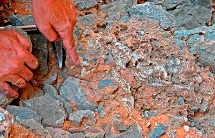
At some Mediterranean islands, dwarf forms of hippos are examples of the “island dwarfism” developed in the Pleistocene, for example the Cretan Hippo (Hippopotamus creutzbergi), the Cyprian (H. minutus), the Maltese Island (H. melitensis) and the Sicilian dwarf hippo (H. pentlandi). Fossil evidence of the Cretan dwarf hippo have been found by NLUK Member (H.Eikamp) on the 22nd of July 2008. Picture above is showing the cranium of H. creutzburgi in situ. Photo: Maria Eleftheria
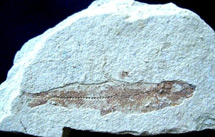
The illustration above shows a fossil (petrified) fish (Spratteloides gracilis), a sprat from the Pliocene (kieselguhr) site Prassas/North Crete
Leaflets
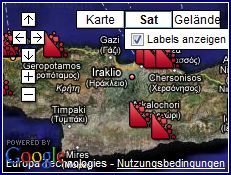
A new late Pleistocene Mammal Locality from Western Crete
011-04/E - Fossil find spots on Crete I
Gouves / Miocene
036-04/E - Fossil find spots on Crete II
Gouves / Miocene
040-04/E - Fossil find spots on Crete III
Foraminifera at Plakias
069-05/E - Fossil find spots on Crete IV
Tsoutsouros
071-05/E - Fossil find spots on Crete V
Pachia Ammos
083-05/E - "Terrible beast"
Deinotherium
092-05/E - 2 new fossil sites from the Miocene of Crete
097-05/E - Fossil site Potamida / Kastelli Kissamos
331-10/E - Tetrapods - footprints
Please see 2nd Page of the leaflet
for the individual topic